
Automotive AC Compressor Failures Analysis & Solutions: 7 Common Issues and Professional Repair Guide
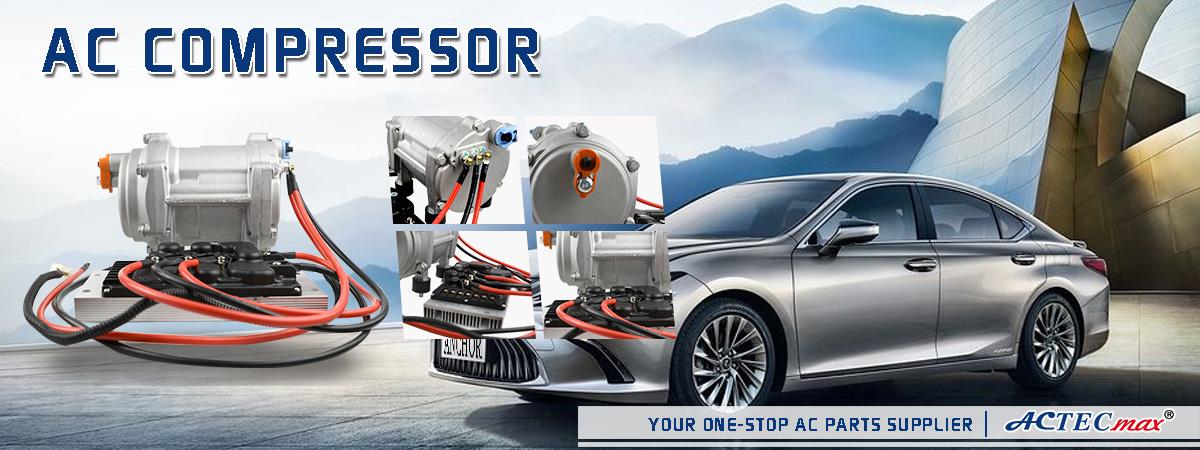
The automotive AC compressor is the core component of the air conditioning system, directly affecting passenger comfort and overall system efficiency. Anchor Group, a leading B2B supplier of automotive AC parts, provides high-quality OEM and aftermarket compressors and professional repair solutions. This article systematically summarizes common AC compressor failures, root causes, detection methods, and troubleshooting measures to help repair shops, fleet operators, and distributors efficiently solve AC issues.
1. Compressor Functions and Requirements
1.1 Key Functions
- Suction Function: Draws low-pressure refrigerant gas from the evaporator into the compressor cylinder, reducing evaporator pressure and promoting refrigerant evaporation.
- Compression Function: Compresses low-pressure, low-temperature gas into high-pressure, high-temperature gas for heat transfer.
- Circulation Function: Drives refrigerant through the condenser, evaporator, and other system components, completing heat exchange.
1.2 Special Requirements
- Compact and lightweight for easy vehicle integration
- High durability, low noise, and stable operation
- Maintain cooling performance at low speed/idle, low energy consumption at high speed
- Low manufacturing cost, easy installation, and maintenance
2. Compressor Types and Working Principle
2.1 Comparison of Compressor Types
| Type | Features | Application |
| Crankshaft Piston | Mature technology, low cost, large size, high vibration | Early, medium, and large vehicles |
| Axial Piston | Compact, lightweight, high-speed, efficient, reliable | Swash plate and wobble plate compressors |
| Rotary | Simple structure, few components, low noise, high efficiency | Scroll, rolling rotor, and screw compressors |
2.2 Scroll Compressor Working Principle
- Structure: Composed of a moving scroll, fixed scroll, anti-rotation mechanism, shaft, and support frame.
- Operation: The moving scroll rotates along its axial direction, creating a continuously changing, sealed, crescent-shaped volume to perform suction, compression, and discharge.
- Advantages: Compact, stable operation, high efficiency, energy-saving, widely used in modern automotive AC systems.
3. Common AC Compressor Failures and Troubleshooting
| Failure Type | Symptoms | Root Cause | Detection | Troubleshooting |
| No Power / Won’t Start | The electromagnetic clutch does not respond | Poor contact, blown fuse, relay coil fault, low-pressure protection triggered | Electrical check, low-pressure switch, thermistor test | Tighten or replace components; adjust the low-pressure switch; refill refrigerant and add compressor oil |
| Stuck / Won’t Rotate | Compressor cannot turn | Insufficient lubrication, slipping drive belt, or clutch fault | Check belt tension and refrigerant circulation | Clean pipelines/valves; refill compressor oil; tighten or replace drive belt |
| Compressor Leakage | Oil or refrigerant leakage detected | Loose pipe joints, worn seals | Loose components or a slipping belt | Repair leak; refill refrigerant and compressor oil |
| Noise (Clutch Disengaged) | Squeaking, bearing noise | Clutch bearing damage or contamination | Inspect bearings, clutch, belt, and pulley | Replace clutch/bearing; tighten screws; adjust friction gap (0.3–0.6mm) |
| Noise (Clutch Engaged) | Friction or impact noise | Inspect the belt, pulley, and AC mounting bolts | Tighten components; adjust or replace belt; repair or replace the compressor | Tighten components; adjust or replace the belt; repair or replace the compressor |
| Insufficient Cooling | High airflow temperature, abnormal pressure | Low/high refrigerant, condenser overheating, air/water/contaminants in system, internal leakage, loose belt | Pressure gauge, sight glass, vacuum test | Adjust refrigerant level; clean system; replace drier or expansion valve; repair/replace compressor; adjust belt tension |
| Clutch Overheating | Excess current or coil burnout | Electrical short or overload | Measure current, check coil resistance | Replace clutch coil or entire clutch assembly |
4. Installation and Routine Maintenance
4.1 Installation Requirements
- Install the compressor at the front of the engine, connected via drive belt to the crankshaft pulley.
- Align pulley planes with the engine crankshaft to avoid noise and premature wear.
- Maximum pipe deviation ≤45° to prevent oil leakage.
- Belt tension: new belt deflection 8–10mm, old belt 11–12mm.
4.2 Routine Maintenance
- Periodic Operation: Start every two weeks for ≥5 minutes to ensure refrigerant circulation and lubricate shaft seals.
- Check Belt Tension: Rated 376 N ±50 N; too loose causes slippage, too tight damages bearings.
- Inspect for Leaks and Oil Residue: Keep shaft seals and pipe joints clean to detect leaks early.
- System Cleaning: Clean condenser, evaporator, and pipelines as needed to maintain cooling efficiency.
5. Anchor Group Professional Support
Anchor Group provides:
- High-quality OEM and aftermarket AC compressors
- Complete repair tools and equipment (manifolds, recovery units, vacuum pumps)
- Technical support and solution consulting
- Fast logistics and global delivery
Our B2B partners benefit from a one-stop platform for AC parts procurement and technical support, ensuring long-term efficient operation of automotive AC systems.
6. Conclusion
Systematic AC compressor failures analysis, troubleshooting measures, and professional maintenance solutions can significantly improve the reliability and efficiency of automotive AC compressors. Leveraging Anchor Group’s high-quality components and tools, B2B customers can resolve compressor issues efficiently, reduce repair costs, and improve client satisfaction.
