
Essential Knowledge of Bus Air Conditioning
1. What is a Bus Air Conditioning System?
A bus air conditioning system is a specialized HVAC (Heating, Ventilation, and Air Conditioning) solution designed specifically for buses, coaches, and other large passenger vehicles. Unlike standard car AC systems, bus air conditioners are larger, more powerful, and more complex, engineered to maintain a comfortable cabin environment for a high number of passengers. They regulate temperature, humidity, and air quality through cooling, heating, and ventilation cycles.
2. Working Principle and Key Components
Similar to conventional automotive air conditioning, a bus AC system operates through four core processes: compression, condensation, expansion, and evaporation. Key components include:
- Compressor: Pressurizes low-pressure refrigerant gas into high-pressure, high-temperature gas.
- Condenser: Releases heat from the refrigerant to the outside air, converting it to a high-pressure liquid.
- Expansion Device / Valve: Reduces refrigerant pressure, cooling it before it enters the evaporator.
- Evaporator: Absorbs heat from cabin air as the refrigerant evaporates, cooling and dehumidifying the air.
- Additional Components: Air ducts, fans, control panels, sensors, piping, refrigerant, and condensate
- pumps ensure smooth airflow and efficient operation.
When the cabin temperature exceeds the set value, the thermostat activates the compressor, which compresses low-pressure refrigerant gas from the evaporator into high-pressure, high-temperature gas; this gas then passes through the condenser, where external fans dissipate heat and convert it into high-pressure liquid, which flows through a dryer and sight glass into the expansion valve to drop its pressure before entering the evaporator, where it absorbs heat from the cabin air and evaporates, while fans circulate cooled air evenly, condensed water is drained, and the low-pressure refrigerant returns to the compressor to continue the cycle.
3. Installation Methods and Locations
Through this continuous cycle of compression, condensation, expansion, and evaporation, bus AC systems ensure stable, high-efficiency cooling for passenger comfort.
| Installation Type | Typical Location | Advantages | Suitable Bus Types |
|---|---|---|---|
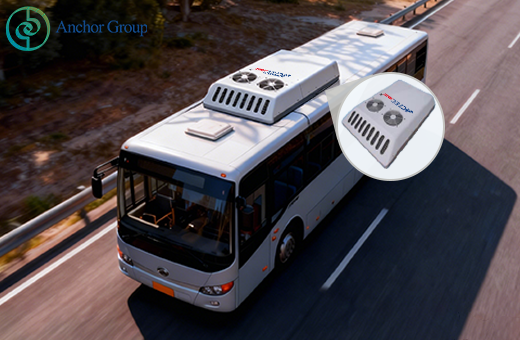
| Roof-Mounted | Top of vehicle | High heat dissipation, even air distribution, frees interior space | Most buses, especially single-deck and long-distance buses |
| Skirt-Mounted | Bottom side skirt | Saves roof space, lowers center of gravity | Double-decker or buses with limited roof space |
| Rear-Mounted | Rear of vehicle | Flexible installation, easy maintenance, suitable for long wheelbase | Long coaches, luxury long-distance buses |
| Engine-Mounted | Engine compartment | Uses engine power, reduces cost | Small/medium buses, city buses |
| Integrated / OEM | Integrated during vehicle production | Optimal performance, low noise, aesthetic design | All bus types, especially high-end/custom models |
| Aftermarket | Flexible (roof, bottom, rear) | Flexible choice of model and location | Bus retrofits and upgrades |
4. Differences Between Bus AC and Standard Car AC
| Aspect | Bus AC | Standard Car AC |
|---|---|---|
| Cooling Capacity | High, multi-circuit or high-power compressor | Moderate, single-circuit sufficient |
| Air Circulation | Multiple ducts and outlets for even distribution | Mainly dashboard vents, limited coverage |
| Dehumidification & Filtration | High emphasis, ensures long-term comfort | Limited, focuses on short trips |
| Installation Location | Roof, skirt, rear, or engine | Engine compartment, dashboard evaporator |
| Control System | Independent, multi-zone control possible | Simple, single-zone control |
| Maintenance & Lifespan | Complex system, long-lasting components, replaceable | Simple, short maintenance cycles |
Summary: Bus AC systems are larger, more complex, and emphasize passenger comfort, air quality, and multi-zone control compared to standard car AC.
5. How to Choose the Right Bus AC Control System
Consider the following factors:
- Passenger Comfort:
- Supports multi-zone temperature control
- Adjustable airflow, effective dehumidification and filtration
- Low operational noise
- Passenger Comfort:
- System Type & Installation:
- Select based on bus type (roof, skirt, rear, engine)
- Decide if an independent power supply or an engine-driven
- System Type & Installation:
- Cooling Capacity:
- Match refrigerating power to cabin size, passenger count, and climate
- Single-circuit for small buses, multi-circuit for large or double-decker buses
- Cooling Capacity:
- Energy Efficiency:
- Inverter compressors or high-efficiency designs
- Electric-driven systems can improve fuel/electricity efficiency
- Energy Efficiency:
- Maintenance & Reliability:
- Easy-to-replace components, durable and corrosion-resistant
- Strong dust and water protection
- Maintenance & Reliability:
- Brand & After-Sales Service:
- Reliable manufacturers with professional support
- Brand & After-Sales Service:
- Smart Control & Connectivity:
- Supports in-cabin thermostats, remote control, or CAN bus integration
- Monitor temperature, humidity, and system status
- Smart Control & Connectivity:
In short: A high-quality bus AC control system should balance comfort, cooling efficiency, energy savings, reliability, and intelligent control.
6. Conclusion
Bus air conditioning systems are essential for providing a comfortable and healthy environment for passengers, especially on long-distance or high-capacity buses. They differ significantly from standard car AC systems in size, complexity, and performance. By understanding the working principle, installation options, and control system features, fleet operators and buyers can make informed decisions to select the most efficient, reliable, and comfortable air conditioning solutions for their buses.
Ensure reliable and efficient climate control for your buses—request a consultation with our experts now.
Email:admin1@acparts.cn
Phone:+86-0574-87392876
Official Website: onestopacparts.com
